
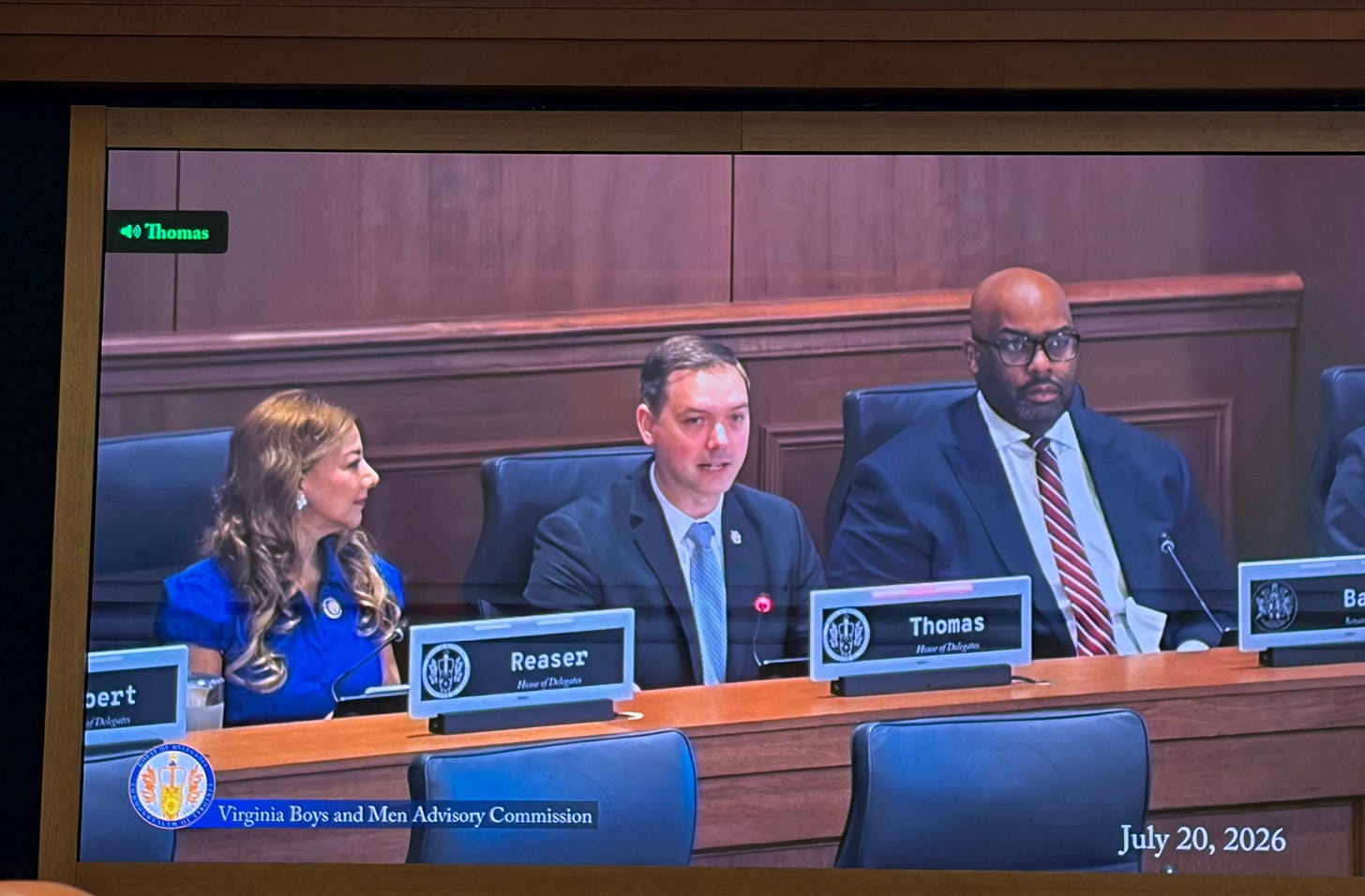
On Monday, Virginia took another historic step for boys and men.
The Virginia Boys and Men Advisory Commission held its first meeting since being established by the General Assembly earlier this year. The bipartisan commission—the first legislatively created permanent state body of its kind in the country—will advise lawmakers on education, health, economic opportunity and the effects of social media on Virginia’s boys and men.
The two-hour session, as well as the media coverage from the Richmond Times-Dispatch, 12 On Your Side, WAVY 10 and WRIC, focused heavily on one urgent issue: Virginia’s boys are falling behind in school.
Data presented by the American Institute for Boys and Men showed that boys enter kindergarten behind girls and continue losing ground. Virginia has the nation’s largest gender gap in fourth-grade reading. Boys are also more likely to drop out of high school, while young men trail women by approximately 10 percentage points in earning college degrees. “There are data trends that have never been seen before in American history of challenges facing men,” said Commission Chair Delegate Josh Thomas (D-Prince William).
By nearly all metrics, Virginia boys and young men fare worse than national averages, according to the presentation by Richard Reeves, president of the American Institute for Boys and men and author of Of Boys and Men:

At the same time, fewer men are entering education themselves. Only 16% of education degrees are now awarded to men—a 39% decline since 2003. Men make up just 7% of early-childhood teachers, leaving many children with few, if any, male educators during their formative years. Nationally just one in four undergraduate education degrees are awarded to men. In Virginia, it only 17%.
Curtis Valentine, president of the Male Educator Network and Policy Institute, emphasized the need to recruit more men into classrooms.
Commission members expressed genuine concern for the topic, raising important questions. Sen. Luther Cifers raised an equally important question: Should the goal be simply to help boys conform to the existing education system, or should schools adapt to better engage how many boys naturally learn and develop?
While the initial focus is on boys and academics, the commission’s work will reach far beyond education. Sen. Lamont Bagby pointed to the disproportionate number of boys and men affected by incarceration, gun violence and poor health outcomes. Men account for roughly 80% of Virginia’s suicide deaths.
The first meeting established the scale of the problem. The harder—and more important—work comes next: turning data and proven ideas into policy.
The commission meets again on August 25 as the commission gears up to co-host the Virginia Blueprint: A Summit Advancing Boys and Men on Sept. 18 at the General Assembly.

Virginia Boys and Men Resources and Stats
Virginia Advisory Commission for Boys and Men meeting info
Challenges and Opportunities Facing Virginia Boys American Institute for Boys and Men’s presentation detailing ways boys are especially challenged in the Commonwealth
Virginia Boys/Men Fact Sheet AIBM 2-page summary of the work to be done
Virginia is for Teachers Presentation from Curtis Valentine, president of the Male Educator Network and Policy Institute
Troops to Teachers College of William and Mary
Commission News Coverage
Scholar James Nuzzo’s newsletter